
I still remember the first time I saw kinematic equations on a whiteboard. They looked like a pile of symbols with no obvious pattern. Then one worked example changed everything: once I saw how displacement, velocity, acceleration, and time fit together, the formulas stopped feeling random and started behaving like tools.
Kinematic Equations sit at the heart of introductory physics because they let you describe motion with precision. Whether you are studying for a school exam, solving engineering basics, or refreshing your understanding of mechanics, these equations help you predict how objects move when acceleration stays constant.
In this guide, I will break the topic down in plain English. You will learn what each variable means, when each equation works, how to choose the right formula, and how to avoid the mistakes that trap many students. I will also walk through examples, graph connections, and common exam strategies so you can move from memorizing formulas to actually understanding them.
What Are Kinematic Equations?
Kinematic Equations are formulas that describe motion without worrying about the forces that cause it. That is the key difference between kinematics and dynamics. In kinematics, you focus on what the motion looks like. In dynamics, you ask why it happens.
These equations work when acceleration is constant. That could mean an object is speeding up at a steady rate, slowing down at a steady rate, or falling under gravity near Earth if you ignore air resistance. In those cases, the motion follows predictable patterns.
You may also hear them called the equations of motion or SUVAT equations. SUVAT is a memory aid based on the variables involved:
- s = displacement
- u = initial velocity
- v = final velocity
- a = acceleration
- t = time
The power of Kinematic Equations comes from how efficiently they connect these five quantities. If you know enough of them, you can solve for the missing one.
Why They Matter in Real Life
Kinematic thinking shows up everywhere. A car braking at a traffic light, a ball thrown upward, a train leaving a station, and a drone climbing vertically can all be analyzed with the same framework.
That is why these formulas matter beyond exams. They train you to describe change over time in a structured way, which is a skill that carries into engineering, robotics, data modeling, and many areas of applied science.
Internal link opportunity: How to Read Velocity Time Graphs in Physics
Internal link opportunity: Newton’s Laws of Motion Explained for Beginners
The Core Quantities in Kinematics
Before you touch a formula, you need to understand the variables. This is where many problems are won or lost.
Displacement
Displacement is the change in position. It is not always the same as distance. Distance tells you how much ground an object covers. Displacement tells you how far the object ends up from where it started, including direction.
If a runner goes 5 meters east and then 3 meters west, the distance is 8 meters, but the displacement is 2 meters east.
Velocity
Velocity is speed with direction. If direction matters, velocity matters. A car moving north at 20 meters per second has a different velocity from a car moving south at 20 meters per second.
Initial velocity is where motion starts. Final velocity is where motion ends after a period of acceleration.
Acceleration
Acceleration tells you how quickly velocity changes. Positive acceleration does not always mean speeding up. It simply means acceleration points in the positive direction you chose.
This sign convention matters. A moving object can have negative acceleration and still speed up if it is moving in the negative direction. That detail often confuses students, so set your positive direction clearly before solving anything.
Time
Time tracks how long the motion lasts. In Kinematic Equations, time is almost always measured in seconds in standard physics problems.
Units Matter More Than Students Expect
Kinematics is unforgiving about units. If velocity is in meters per second, acceleration should be in meters per second squared, displacement in meters, and time in seconds.
A student might know the right formula and still get the wrong answer because they used kilometers per hour with meters per second squared. Unit consistency is not a side issue. It is part of the solution.
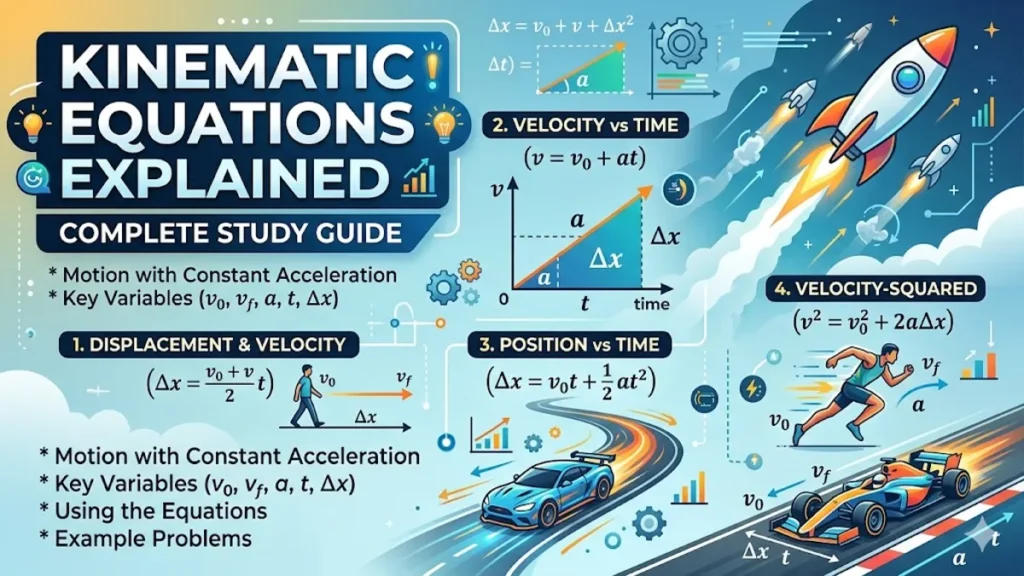
The Four Main Kinematic Equations
Here are the standard constant acceleration equations you will use most often:
1. Final Velocity Equation
v=u+at
This equation tells you how velocity changes over time under constant acceleration.
Use it when you know:
- initial velocity
- acceleration
- time
And you want:
- final velocity
2. Displacement Equation With Time
s=ut+21at2
This equation gives displacement when you know the starting velocity, acceleration, and time.
Use it when you know:
- initial velocity
- acceleration
- time
And you want:
- displacement
3. Velocity Displacement Equation
v2=u2+2as
This one connects velocity, acceleration, and displacement without using time. That makes it incredibly useful when time is missing from the problem.
Use it when you know:
- initial velocity
- acceleration
- displacement
And you want:
- final velocity
4. Average Velocity Form
s=2(u+v)t
This equation says displacement equals average velocity times time when acceleration is constant. Since velocity changes linearly under constant acceleration, the average velocity is simply the midpoint between initial and final velocity.
Use it when you know:
- initial velocity
- final velocity
- time
And you want:
- displacement
A Useful Extended Form
Sometimes you also see:s=vt−21at2
This is not a separate law. It is just another rearranged form that can help when final velocity is known instead of initial velocity.
Image suggestion: A clean infographic showing all four kinematic equations, their variables, and when to use each one.
When You Can and Cannot Use These Equations
This is the rule students should write in the margin of every worksheet: Kinematic Equations only work directly when acceleration is constant.
If acceleration changes during the motion, these formulas no longer describe the whole motion in one step. You may need calculus, piecewise analysis, or numerical methods.
Situations Where They Work Well
- Free fall near Earth without air resistance
- A car accelerating steadily
- An object slowing down at a constant rate
- Motion along a straight line with fixed acceleration
Situations Where They Do Not Work Directly
- A parachute falling with significant air resistance
- A rocket burning fuel with changing thrust
- A car accelerating irregularly in traffic
- Circular motion with changing direction and nonconstant acceleration
The Gravity Shortcut
For vertical motion near Earth, acceleration is often written as:a=−9.8m/s2
if you choose upward as positive.
Or:a=+9.8m/s2
if you choose downward as positive.
Neither is more correct. What matters is consistency. Pick a direction and stick to it from start to finish.
For editorial reference, an external source such as a standard introductory physics text or educational resources from organizations like Khan Academy or OpenStax can support this section.
How to Choose the Right Equation
The hardest part of many motion problems is not algebra. It is picking the right starting point.
I like to think of Kinematic Equations as a matching exercise. List what you know, circle what you need, and choose the formula that contains those variables without including an extra unknown.
A Simple Selection Strategy
Step 1: Write Down the Known Variables
Make a quick list of:
- u
- v
- a
- t
- s
Step 2: Identify the Missing Quantity
Ask yourself what the problem wants. Is it final velocity, displacement, or time?
Step 3: Avoid Unnecessary Unknowns
Pick the equation that uses the variables you already know and the one you want to find. If an equation includes two unknowns, it is usually not the best first move.
Quick Matching Guide
- Need v and know u, a, t
Use: v=u+at - Need s and know u, a, t
Use: s=ut+21at2 - Need v and know u, a, s
Use: v2=u2+2as - Need s and know u, v, t
Use: s=2(u+v)t
Why This Method Works
Most students get stuck because they look at all formulas at once and panic. A better approach is mechanical. Treat the problem like a checklist. Once you train your eyes to scan for known and unknown variables, the right equation often becomes obvious.
Internal link opportunity: How to Solve Physics Word Problems Without Guessing
Internal link opportunity: The Best Study Techniques for STEM Exams
Worked Examples With Step by Step Solutions
Theory matters, but Kinematic Equations become clear when you solve actual problems.
Example 1: Car Accelerating From Rest
A car starts from rest and accelerates at 3m/s2 for 5 seconds. Find its final velocity.
Given
- u=0
- a=3m/s2
- t=5s
Use the Formula
v=u+at
Substitute
v=0+(3)(5)=15m/s
Answer
The final velocity is:15m/s
Example 2: Finding Displacement
A bicycle moves with an initial velocity of 4m/s and accelerates at 2m/s2 for 6 seconds. How far does it travel?
Given
- u=4
- a=2
- t=6
Use the Formula
s=ut+21at2
Substitute
s=(4)(6)+21(2)(62) s=24+36=60m
Answer
The bicycle travels:60m
Example 3: Braking Car
A car moving at 20m/s brakes uniformly and comes to rest in 40 meters. Find the acceleration.
Given
- u=20
- v=0
- s=40
Use the Formula
v2=u2+2as
Substitute
02=202+2a(40) 0=400+80a 80a=−400 a=−5m/s2
Answer
The acceleration is:−5m/s2
The negative sign tells you the car is slowing down relative to the chosen positive direction.
Example 4: Object Thrown Upward
A ball is thrown upward with an initial velocity of 15m/s. How high does it rise before stopping momentarily?
Given
- u=15
- v=0
- a=−9.8
Use the Formula
v2=u2+2as
Substitute
0=152+2(−9.8)s 0=225−19.6s 19.6s=225 s≈11.48m
Answer
The ball rises about:11.5m
Image suggestion: A worked example graphic with a vertical motion diagram, sign convention labels, and the formula highlighted.
How Graphs Connect to Kinematic Equations
Students often memorize formulas and forget that these equations come from graph relationships. Once you see that connection, the formulas feel much less arbitrary.
Position Time Graph
A position time graph shows where an object is over time. The slope of the graph gives velocity.
If the slope gets steeper, velocity is increasing. If the graph curves, acceleration is present.
Velocity Time Graph
This is the most useful graph in kinematics.
- The slope of a velocity time graph gives acceleration.
- The area under the graph gives displacement.
That means if velocity changes linearly, acceleration is constant. This is exactly the condition that makes Kinematic Equations valid.
Acceleration Time Graph
An acceleration time graph shows how acceleration changes over time. If it is a horizontal line, acceleration is constant, and the standard equations apply cleanly.
Why the Graph View Helps
The average velocity equation,s=2(u+v)t
makes more sense when you picture the area under a straight line on a velocity time graph. The graph forms a trapezoid. Its area equals displacement. That is not just a neat trick. It is the geometric logic behind the formula.
For editorial reference, external sources such as OpenStax Physics and classroom graphing resources from reputable educational publishers can strengthen this section.
Common Mistakes Students Make
Even strong students lose marks on kinematics because of small setup mistakes. Here are the ones I see most often.
Mixing Up Distance and Displacement
Distance is scalar. Displacement is vector. When direction matters, treating them as the same thing leads to incorrect signs and wrong answers.
Ignoring Sign Conventions
If upward is positive, gravitational acceleration must be negative. If left is negative, then velocities pointing left must carry a negative sign. You cannot switch conventions midway through a solution.
Using the Wrong Formula
Students often grab the first equation they remember rather than the equation that matches the known variables. This usually creates unnecessary algebra or introduces extra unknowns.
Forgetting That Constant Acceleration Is Required
This is the big conceptual error. Kinematic Equations do not magically fit every motion problem. If the acceleration changes, you must rethink the model.
Dropping Units
Physics answers without units are incomplete. Units also act like a built in error check. If your displacement answer ends in seconds, something went wrong.
Squaring Errors in the Third Equation
Inv2=u2+2as
students sometimes forget to square the initial velocity or mishandle square roots when solving for v. Also remember that taking a square root can produce positive or negative values depending on physical context.
Image suggestion: A “common mistakes” infographic with sign convention examples and unit checks.
Expert Study Tips for Mastering Kinematic Equations
If you want these formulas to stick, do not study them as isolated math facts. Study them as patterns of motion.
Build a Variable Map
Write the five variables in a box before every problem. Fill in what you know and cross out what is missing. This simple routine reduces careless mistakes.
Draw a Tiny Motion Sketch
A quick arrow diagram or vertical path helps you track direction, starting conditions, and what the object is doing physically. A ten second sketch often saves five minutes of confusion.
Practice Rearranging Equations
Many students only practice substituting values. Go one level deeper. Rearrange formulas for different variables so you get comfortable manipulating them under pressure.
Connect Formulas to Graphs
When you solve a problem, ask what the velocity time graph would look like. This habit strengthens intuition and helps you see whether your answer makes physical sense.
Use Free Fall as a Pattern Builder
Vertical motion problems are excellent training because the acceleration stays constant. Practice thrown upward, dropped, and downward launch problems until the sign conventions feel natural.
Check the Story of the Answer
A negative displacement, a positive acceleration, or a final speed larger than the initial one all tell a story. Ask whether that story matches the physical situation. Physics gets easier when you stop seeing equations as symbols and start seeing them as descriptions of reality.
Internal link opportunity: Best Physics Revision Methods for High School and College Students
Internal link opportunity: How AI Study Tools Can Help You Learn Faster
Frequently Asked Questions
What are the 4 kinematic equations?
The four main Kinematic Equations are v=u+at, s=ut+21at2, v2=u2+2as, and s=2(u+v)t. They connect displacement, initial velocity, final velocity, acceleration, and time when acceleration remains constant.
When can I use kinematic equations?
You can use Kinematic Equations when motion happens in a straight line or along one axis and acceleration stays constant throughout the interval. They are especially useful for free fall, steady acceleration, and uniform deceleration problems.
What does SUVAT stand for?
SUVAT stands for displacement, initial velocity, final velocity, acceleration, and time. It is a memory tool that helps students remember the five variables used in constant acceleration motion problems.
Do kinematic equations work for variable acceleration?
Not directly. If acceleration changes over time, the standard constant acceleration equations no longer describe the full motion in one step. In those cases, you often need calculus, graphs, or a piecewise approach.
What is the difference between velocity and acceleration?
Velocity measures how quickly position changes and includes direction. Acceleration measures how quickly velocity changes. An object can have velocity without acceleration, and it can also accelerate while slowing down if acceleration points opposite the motion.
Which kinematic equation does not use time?
The equation v2=u2+2as does not include time. It is especially useful when a problem gives initial velocity, acceleration, and displacement but does not mention how long the motion lasts.
Final Thoughts
Kinematic Equations become much easier once you stop treating them like a formula sheet and start seeing them as a connected system. Each equation tells a specific story about motion under constant acceleration. Once you know what the variables mean and when the rules apply, the subject starts to feel logical instead of intimidating.
If you are studying physics right now, focus on three habits: define your variables, choose signs carefully, and match the equation to the information you actually have. That small shift will improve your accuracy fast. For related reading on saaswriterhub.com, consider linking this piece to future articles such as Newton’s Laws of Motion Explained, Velocity Time Graphs Made Simple, and How to Study Physics More Effectively in 2026.
To explore more insights like this, click here to learn more about education topics.