I’ve seen candidates with perfect resumes lose offers simply because they ignored one small but critical step: sending a thank you email after interview. In today’s competitive job market, where hiring managers evaluate not just skills but professionalism and communication, this follow-up can quietly tip the scales in your favor.
A well-crafted thank you email after interview does more than show gratitude. It reinforces your interest, reminds the interviewer why you’re a strong fit, and keeps you top-of-mind during decision-making. According to hiring data from organizations like the Society for Human Resource Management (SHRM), timely follow-ups can positively influence hiring decisions when candidates are closely matched.
In this guide, I’ll break down exactly how to write a compelling post-interview email, share proven templates, highlight common mistakes, and show you how to stand out without sounding robotic.
Why a Thank You Email After Interview Matters
Most candidates underestimate this step. That’s a mistake.
A thank you email after interview serves three strategic purposes:
Reinforces Your Interest
Hiring managers want candidates who are genuinely interested. A thoughtful email signals enthusiasm without saying it outright.
Strengthens Your Personal Brand
Your resume shows qualifications. Your email shows professionalism, communication skills, and attention to detail.
Keeps You Top-of-Mind
Recruiters often interview multiple candidates back-to-back. A follow-up email helps them remember you clearly.
In competitive roles, especially in business and tech sectors, small differentiators matter. This is one of them.
When to Send Your Thank You Email
Timing is critical.
Ideal Timing: Within 24 Hours
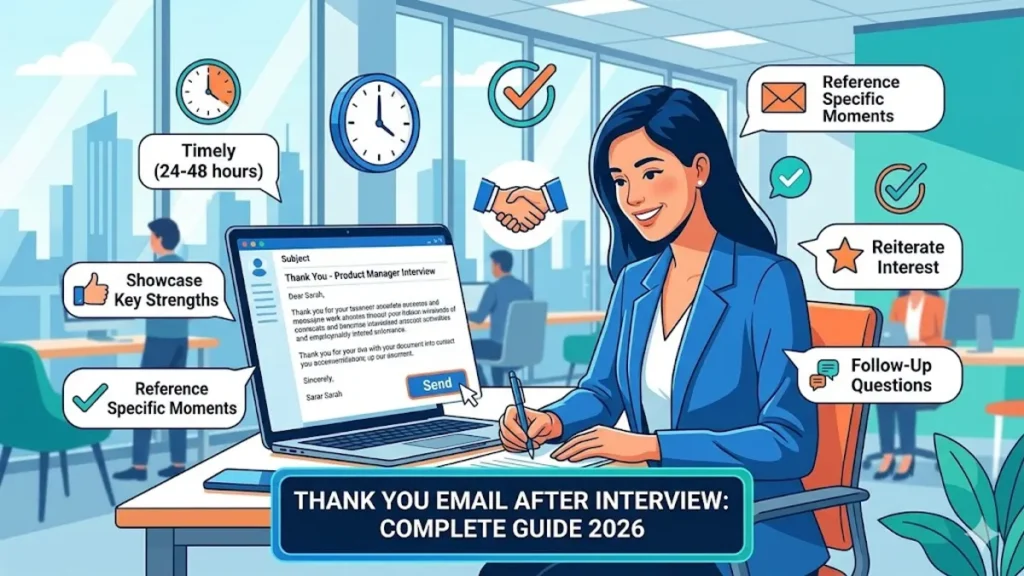
Send your thank you email within 24 hours of the interview. This ensures your conversation is still fresh in the interviewer’s mind.
Same-Day Advantage
If possible, send it within 4–6 hours. This shows responsiveness and professionalism.
Avoid These Timing Mistakes
- Waiting more than 48 hours
- Sending immediately without thought
- Forgetting to send one at all
Consistency matters. If you’re interviewing with multiple people, send individual emails to each.
How to Write a Thank You Email After Interview
A strong email follows a simple but effective structure.
1. Subject Line That Gets Opened
Keep it clear and professional:
- Thank You – [Your Name]
- Great Speaking With You Today
- Appreciation for the Interview Opportunity
Avoid vague or overly casual subject lines.
2. Start With Genuine Gratitude
Open by thanking the interviewer for their time.
Example:
“Thank you for taking the time to meet with me today. I enjoyed our discussion about your team’s upcoming projects.”
3. Personalize the Message
Reference something specific from the interview.
This could be:
- A project they mentioned
- A challenge the company is facing
- A shared interest
This shows you were engaged and attentive.
4. Reinforce Your Value
Briefly highlight why you’re a strong fit.
Example:
“Our discussion about scaling customer acquisition aligns closely with my experience in data-driven marketing strategies.”
Keep it concise. This is not a second cover letter.
5. Express Continued Interest
Make it clear you’re still interested in the role.
Example:
“I’m very excited about the opportunity to contribute to your team.”
6. Close Professionally
End with a polite closing.
Example:
“Thank you again for your time and consideration. I look forward to hearing from you.”
Proven Thank You Email Templates
Here are templates you can adapt depending on your situation.
Template 1: Standard Professional
Subject: Thank You – [Your Name]
Dear [Interviewer’s Name],
Thank you for taking the time to meet with me today. I enjoyed learning more about the role and your team’s approach to [specific topic].
Our discussion about [specific detail] particularly stood out to me, and it reinforced my interest in the position. I believe my experience in [relevant skill] would allow me to contribute effectively.
Thank you again for your time and consideration. I look forward to hearing from you.
Best regards,
[Your Name]
Template 2: More Conversational
Subject: Great Speaking With You
Hi [Name],
I really enjoyed our conversation today about [topic]. It gave me a clear picture of the exciting work your team is doing.
I’m especially interested in how you’re tackling [specific challenge], and I’d love the opportunity to contribute my experience in this area.
Thanks again for your time. I hope we can stay in touch.
Best,
[Your Name]
Template 3: After Panel Interview
Subject: Thank You for the Opportunity
Dear [Interviewer’s Name],
Thank you for the opportunity to meet with you and the team. I appreciated the chance to learn more about your organization and discuss how I can contribute.
Each conversation gave me valuable insights, especially regarding [specific insight]. It strengthened my enthusiasm for joining your team.
I appreciate your time and consideration and look forward to next steps.
Sincerely,
[Your Name]
Common Mistakes to Avoid
Even strong candidates slip up here.
Writing a Generic Email
If your email could be sent to any company, it won’t stand out.
Being Too Long
Keep it under 150–200 words. Hiring managers are busy.
Over-Selling Yourself
This is a follow-up, not a pitch deck.
Forgetting to Proofread
Spelling or grammar mistakes can undo a great interview.
Copy-Pasting Templates Without Editing
Templates help, but personalization wins.
Advanced Tips to Stand Out
Once you master the basics, these strategies can elevate your email.
Add Value Subtly
Mention a relevant idea or resource.
Example:
“I came across an article on [topic] that aligns with our discussion and thought you might find it interesting.”
This shows initiative without being pushy.
Mirror Their Tone
If the interviewer was formal, keep it formal.
If they were conversational, you can relax slightly.
Follow Up Again If Needed
If you don’t hear back after a week, send a polite follow-up.
For deeper career strategies, you might explore internal content like:
- Internal link opportunity: How to Follow Up After a Job Interview in 2026
- Internal link opportunity: Top Job Interview Mistakes to Avoid
Use It as a Relationship Builder
Even if you don’t get the job, this email keeps the door open for future opportunities.
Expert Tips for Writing a Thank You Email After Interview
- Send within 24 hours without fail
- Personalize every email with specific details
- Keep it concise and focused
- Reinforce value without repeating your resume
- Always proofread before sending
- Maintain a professional yet human tone
These small actions compound into a strong professional impression.
Frequently Asked Questions (FAQ)
Should I always send a thank you email after interview?
Yes. Even if the interview felt informal, sending a thank you email shows professionalism and respect. It’s a standard expectation in most industries and can influence hiring decisions when candidates are closely matched.
What if I forgot to send it on time?
Send it anyway. A slightly late thank you email is better than none. Acknowledge the delay briefly and focus on expressing appreciation and interest.
Can I send the same email to multiple interviewers?
No. Each email should be personalized. Mention something specific from your conversation with each interviewer to make it meaningful.
Is a thank you email enough as a follow-up?
It’s the first step. If you don’t hear back within a week, send a polite follow-up email asking for updates on the hiring process.
Should I send a handwritten thank you note?
In 2026, email is faster and more effective. A handwritten note can be a nice touch, but it should never replace an email.
Final Thoughts
A thank you email after interview is one of the simplest yet most powerful tools in your job search. It doesn’t require special skills, but it demands attention, timing, and authenticity.
I’ve watched hiring decisions come down to subtle signals like this. When two candidates look similar on paper, the one who communicates better often wins. This email is your chance to reinforce your value one last time.
Treat it seriously, personalize it thoughtfully, and send it promptly. That small step can quietly move you from “strong candidate” to “top choice.”
To explore more insights like this, click here to learn more about business topics.