
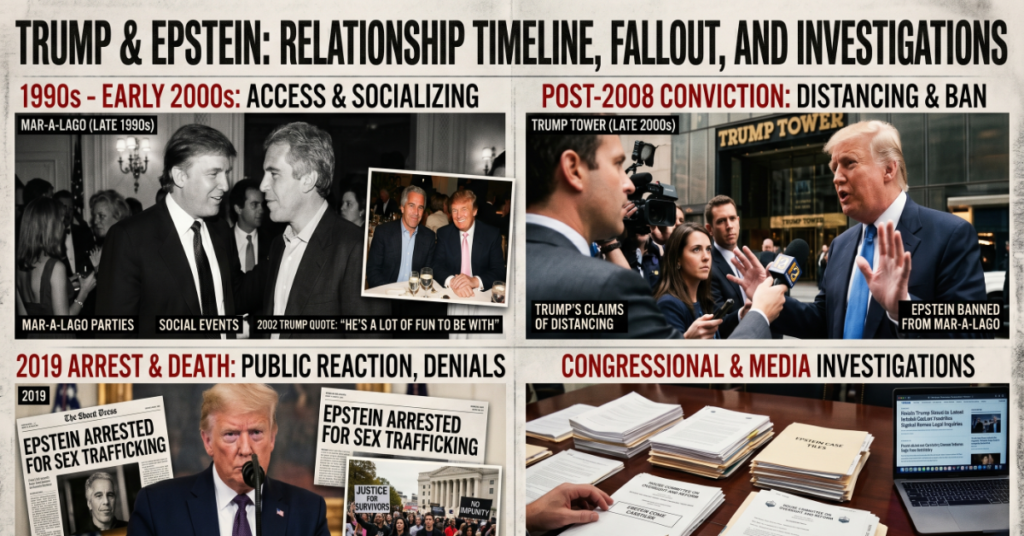
The trump and epstein connection remains one of the most heavily scrutinized intersections of politics, wealth, and criminal investigation in modern American public life. Their association began in overlapping social environments during the late 1980s and 1990s, when both were frequent figures in New York and Palm Beach elite circles.
By the early 2000s, the relationship had shifted significantly, with reports indicating a breakdown in personal ties. The trump and epstein timeline gained renewed attention after Epstein’s 2019 arrest and subsequent death, followed by repeated references in media investigations, court filings, and partial document releases in the mid 2020s.
This article breaks down the evolution of their association, the circumstances around their separation, and how later disclosures reshaped public perception. It also examines legal context, political implications, and the limits of verified evidence in the public record.
Origins of the Trump and Epstein Social Circle
The early phase of the trump and epstein association emerged through shared membership in high-income social environments in New York and Florida. Both men moved within circles of real estate developers, financiers, and social elites during the 1990s.
Epstein’s known networking strategy involved cultivating relationships with influential individuals across business and politics. Trump, as a real estate developer and public figure, frequently appeared in similar social settings.
Key characteristics of this period:
- Overlapping attendance at high-profile social events
- Shared contacts in Palm Beach and Manhattan
- Limited publicly documented private interactions
This phase is primarily reconstructed through media reports and historical photographs rather than formal legal documentation.
Public Statements and Early Perceptions
One of the most frequently cited elements in the trump and epstein narrative is a 2002 magazine interview where Trump described Epstein in positive terms, calling him a “terrific guy” in reference to social familiarity. This statement has been widely circulated in later reporting.
Years later, Trump publicly distanced himself from Epstein, stating that they had not maintained a close relationship and that a personal falling out occurred prior to Epstein’s legal troubles.
These shifts in public framing created a lasting tension between early social acknowledgment and later denial of closeness.
The 2004 Falling Out and Mar-a-Lago Ban
The separation between Trump and Epstein is commonly reported to have occurred around 2004, with later accounts suggesting a dispute involving conduct at Mar-a-Lago.
Reported sequence of events:
| Year | Event | Context |
| Early 2000s | Social distancing begins | Reduced interaction in shared circles |
| 2004 | Alleged fallout | Reported dispute involving conduct concerns |
| 2007 | Mar-a-Lago ban | Epstein reportedly barred from property |
The trump and epstein break is often linked to internal club management decisions and concerns raised about Epstein’s behavior toward a young female staff member, as described in later reporting.
Legal Context and Epstein Investigation Era
Epstein’s 2008 plea agreement and later federal charges in 2019 fundamentally reshaped how past associations were reexamined.
During this period, the trump and epstein narrative resurfaced in media coverage, largely because of earlier photographs and social overlaps.
Legal context overview:
| Category | Detail |
| 2008 case | State-level plea deal in Florida |
| 2019 case | Federal sex trafficking charges |
| 2019 outcome | Epstein died in custody |
Importantly, no publicly released indictment or court filing has charged Trump in relation to Epstein’s crimes.
Post-2019 Political Fallout and Public Statements
Following Epstein’s arrest and death, Trump made public remarks that included comments about Epstein’s death being suspicious and expressed well wishes toward Ghislaine Maxwell during a media exchange, which later drew criticism.
The trump and epstein association became a recurring topic in political discourse, particularly in campaign environments where opposition groups referenced historical social connections.
Key developments:
- Increased media focus on past social interactions
- Reinterpretation of historical statements
- Expansion of conspiracy narratives in public debate
2025–2026 Document Releases and Renewed Scrutiny
In 2025, partial disclosures of Epstein-related documents intensified public attention. These included emails referencing various public figures, including Trump, which were widely analyzed in media reporting.
Structured comparison of public claims vs verified record:
| Claim Type | Public Discussion | Verified Status |
| Social association | Documented through photos and events | Confirmed historical overlap |
| Criminal involvement | Alleged in speculation | Not supported by released legal filings |
| Direct evidence | Cited in commentary and emails | No prosecutorial confirmation |
The trump and epstein topic resurfaced again in political debates, protests, and media coverage, particularly around transparency demands for additional document releases.
Strategic and Political Implications
The continued attention around trump and epstein illustrates how historical associations can become persistent political liabilities regardless of legal outcomes.
Strategic implications:
- Long-term reputational sensitivity in political campaigns
- Media amplification cycles during election periods
- Legal boundaries between association and culpability
From an institutional perspective, the issue also highlights challenges in separating verified legal evidence from reputational inference.
Risks, Trade-offs and Information Gaps
The primary challenge in analyzing the trump and epstein narrative lies in uneven information availability.
Key limitations:
- Many interactions were social, not documented legally
- Public record is incomplete regarding private encounters
- Media interpretation often blends verified and unverified claims
Trade-offs in public understanding:
- Transparency demands increase scrutiny
- Lack of full disclosure fuels speculation
- Legal standards differ from public perception thresholds
Expert Insights
- Early association does not imply criminal involvement under legal standards
- Public narratives often expand beyond evidentiary boundaries
- Document releases tend to reshape interpretation rather than establish new legal findings
- Political actors are disproportionately affected by historical social networks
- Epstein-related records remain partially sealed or redacted in key jurisdictions
Frequently Asked Questions
Why did Trump ban Epstein from Mar-a-Lago?
Reports indicate Epstein was barred from Mar-a-Lago following concerns about conduct involving a young staff member. Club management decisions and internal complaints are cited in secondary reporting.
What caused the falling out between Trump and Epstein?
The reported falling out around 2004 is linked to personal and professional disagreements, though exact details remain inconsistently documented in public sources.
Did Trump know about Epstein’s crimes?
No verified legal evidence shows Trump had knowledge of Epstein’s criminal conduct prior to public investigations. Released files have not established direct awareness.
What does the 2025 Epstein document release show?
The 2025 releases included emails and references to multiple public figures, but none provided conclusive evidence of criminal involvement by Trump.
What has Trump said about Epstein’s death?
Trump publicly questioned aspects of Epstein’s death in custody, reflecting broader public speculation at the time, though no official findings support conspiracy claims.
The Future of Trump and Epstein Coverage in 2027
Future scrutiny will likely depend on whether additional sealed records are released through ongoing legal or congressional processes. Regulatory bodies and courts may continue evaluating transparency requests.
Media framing is expected to remain politically polarized, especially during election cycles. However, unless new verified evidence emerges, the legal narrative is unlikely to change significantly.
Methodology
This analysis is based on publicly available court records, government statements, major investigative journalism reports, and historically documented social interactions. Sources include established news organizations and legal filings referenced in public databases.
Limitations include incomplete access to sealed records, redacted documents, and private communications not entered into public evidence. Where interpretations differ, the article prioritizes confirmed legal documentation over speculative reporting.
Counterarguments in media discourse were reviewed to ensure balanced coverage, particularly regarding the distinction between social association and criminal liability.