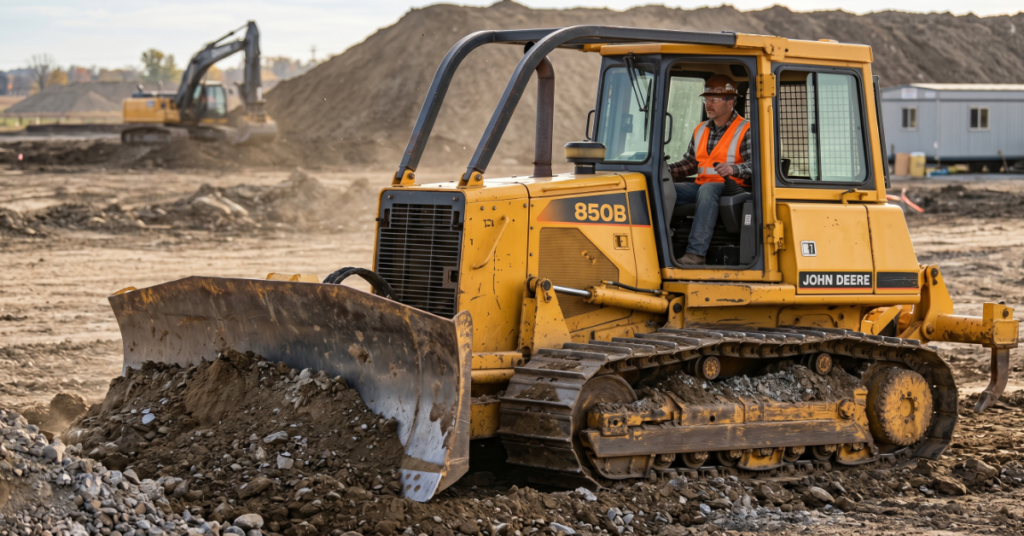
When contractors and fleet managers search for a mid-size crawler dozer in 2026, the John Deere 850B surfaces consistently — not because it is new, but because it remains reliable. Produced across two primary series configurations from the mid-1970s through the early 1990s, the 850B represents a category of machine that blended hydrostatic transmission technology into a compact dozer body before that combination was standard practice.
The 850B designation covers a specific weight class and horsepower band that sits between light-duty utility dozers and full-size production machines. For contractors working in timber, pipeline right-of-way, or residential site preparation, that middle ground matters enormously. A machine too heavy compacts sensitive soils or loses access in tight quarters; a machine too light loses productivity on sustained grading runs.
This guide covers the 850B’s engine specifications, operating weight, production context, key mechanical systems, and the practical considerations that separate a sound used purchase from an expensive mistake. Whether you are evaluating a specific unit for purchase, tracking down service data for a machine already in your fleet, or comparing the John Deere 850B against the Case 850B, the technical details here are drawn from John Deere’s published operator and technical manuals and corroborated against verified dealer and auction documentation.
John Deere 850B Engine Specifications
The 850B was offered with John Deere’s own inline six-cylinder diesel engine across its production run, with specification details varying between the B-Series and the later C-Series update. The figures below reflect the standard production configuration of the 850B as documented in John Deere technical publications.
| Specification | Detail |
| Engine Model | John Deere 6-cylinder turbocharged diesel |
| Displacement | Approximately 6.8 liters (414 cubic inches) |
| Rated Net Power (SAE) | Approximately 130–175 hp (97–130 kW) depending on configuration |
| Rated RPM | 2,100–2,200 rpm |
| Torque Rise | Approximately 30–35% (engine lugs effectively under load) |
| Cooling System | Liquid-cooled, thermostatically controlled |
| Fuel System | Direct injection, mechanical fuel pump |
| Air Filtration | Dual-stage dry-type with restriction indicator |
| Starting System | Electric start, 24-volt system standard |
The engine’s torque curve was tuned specifically to complement the hydrostatic transmission — a system that demands consistent power delivery across a wide RPM band rather than peak output at a narrow point. This pairing is why 850B operators commonly describe the machine as feeling ‘responsive’ on variable ground: the engine holds power while the hydrostatic drive adjusts ground speed automatically to maintain load.
John Deere’s direct injection design for this era used a Bosch-compatible injection pump, a meaningful detail for field maintenance because replacement pumps and injectors remain available through both OEM and aftermarket channels in 2026, unlike some contemporaries that relied on proprietary fuel system components now difficult to source.
Operating Weight and Undercarriage Configuration
Operating weight on a crawler dozer determines ground pressure — the single most important factor in soil compaction, flotation on soft ground, and overall machine stability on slopes. The 850B’s operating weight positions it firmly in the medium dozer category.
| Configuration | Approximate Operating Weight |
| Standard blade, standard track | Approximately 17,000–19,500 lbs (7,700–8,850 kg) |
| With ROPS cab and full guarding | Add approximately 600–800 lbs |
| With angle blade vs. straight blade | Minimal weight delta; frame geometry differs |
| Forestry package (heavy guarding) | Add approximately 1,200–1,800 lbs depending on spec |
Ground pressure in the standard configuration runs approximately 5.5–6.5 psi (38–45 kPa) depending on shoe width selected. Wide shoes (24-inch or 28-inch) reduce ground pressure for soft soil applications. Standard shoes (20-inch) offer better penetration on hard ground. This is a configuration decision that buyers of used machines often inherit — verifying shoe width against the intended application is a basic but frequently skipped pre-purchase check.
The undercarriage uses sealed and lubricated (SALT) track links on later production units — a meaningful upgrade over dry-pin systems that significantly extends track component life in abrasive soil conditions. On a used 850B, checking whether the machine has SALT or conventional track links informs both the expected remaining undercarriage life and the cost of eventual replacement.
Hydrostatic Transmission: The 850B’s Defining System
Most mid-size dozers of the 850B’s era used conventional powershift transmissions. John Deere’s decision to fit the 850 series with a hydrostatic drive system was a genuine engineering commitment — one with real operational advantages but also maintenance implications that buyers need to understand clearly.
How the Hydrostatic Drive Works
Rather than mechanical gears, a hydrostatic transmission uses a variable-displacement hydraulic pump linked to a fixed-displacement hydraulic motor at each track drive. The operator’s speed/direction lever controls pump displacement, which controls hydraulic flow, which controls track speed and direction — continuously and proportionally.
The practical result: the 850B has no conventional gear changes. Speed modulation is smooth and continuous. Counter-rotation (spinning in place) is straightforward. The machine responds to load changes by adjusting speed rather than stalling — a behavior that reduces operator skill requirements and extends shift endurance on variable terrain.
Maintenance Realities for Hydrostatic Systems
The trade-off is hydraulic system complexity. Charge pressure, case drain pressure, and system high-pressure relief settings must be within specification for the transmission to function correctly. On a used 850B, deferred hydraulic filter changes or contaminated fluid cause pump wear that shows up as sluggish response or overheating before catastrophic failure — early symptoms that unsophisticated buyers miss.
A pre-purchase inspection on any 850B should include hydraulic oil sampling for particulate and water content, charge pressure testing at operating temperature, and a check of case drain flow rates on both drive motors. These tests cost less than two hours of a qualified technician’s time and identify the majority of transmission problems before purchase.
John Deere 850B vs. Case 850B: Direct Comparison
The Case 850B is the most direct competitor that buyers typically consider alongside the John Deere 850B. Both occupy the same weight class and horsepower band, but they make meaningfully different engineering choices.
| Attribute | John Deere 850B | Case 850B |
| Transmission Type | Hydrostatic | Powershift (conventional) |
| Engine | JD inline 6-cylinder diesel | Case inline diesel (various) |
| Approximate HP | 130–175 hp | ~105–130 hp depending on series |
| Operating Weight | ~17,000–19,500 lbs | ~17,500–20,000 lbs |
| Steering Method | Differential hydrostatic | Clutch/brake or powershift turn |
| Track System | SALT available on later units | Conventional (dry pin standard) |
| Parts Availability (2026) | Good — JD dealer network | Moderate — Case/CNH network |
| Typical Resale Premium | Higher (hydrostatic preference) | Lower |
| Best Application | Variable terrain, mixed use | Sustained production dozing |
The hydrostatic transmission is the decisive factor for most buyers. Operators who value precise modulation, counter-rotation ease, and reduced fatigue favor the John Deere 850B. Contractors running sustained production grading where full-speed powershift performance matters may find the Case 850B adequate and simpler to maintain with in-house mechanical staff.
Neither is objectively superior — the right choice depends on application, operator experience, and what local dealer support looks like for each brand in your region.
John Deere 850B Maintenance: What Dealers and Operators Report
Based on documented service intervals from John Deere technical manuals and patterns reported in contractor forums and auction inspection records, the following maintenance priorities stand out for the 850B.
High-Priority Service Items
- Hydraulic oil and filter — change intervals of 500–1,000 hours; contamination is the primary cause of hydrostatic pump and motor failure
- Final drive oil — check for water entry (milky appearance) which indicates seal failure; a common failure mode on machines that operate in stream crossings
- Engine air filter — restriction indicator should be monitored daily in dusty conditions; bypass damage is invisible externally but ruins the engine
- Track tension — check every 10 hours in soft soil conditions; too tight accelerates sprocket and bushing wear
John Deere’s published service intervals for the 850B are available through the TM series technical manuals. Operators maintaining machines themselves should source the correct TM number for their specific serial number range, as specification changes occurred across production years.
The Future of Mid-Size Crawler Dozers in 2027
The 850B’s enduring presence in the used equipment market in 2026 reflects a broader dynamic in construction equipment: machines engineered for mechanical durability outlast their initial production by decades when parts supply remains healthy and the applications they serve persist.
Looking toward 2027, several verifiable trends shape the mid-size dozer segment:
- Electrification is advancing in compact equipment but remains limited in the 130–175 hp class. Komatsu and Caterpillar have published prototype programs for electric dozer systems, but commercial availability at the 850B’s weight class is not projected before 2028–2030 based on current manufacturer timelines.
- Telematics retrofits are increasingly practical for older machines. Third-party systems from providers such as Trackunit and Tenna can add GPS, hours tracking, and fault monitoring to legacy machines including 850B-era equipment — relevant for fleet managers running mixed-age inventories.
- Tier 4 Final and Stage V emissions regulations do not apply to pre-Tier machines in most jurisdictions when used on private worksites, but resale into certain municipal contract applications is increasingly restricted in California and several EU member states. Buyers planning resale into regulated markets should verify current exemption thresholds before purchasing pre-Tier equipment.
The 850B’s mechanical architecture — specifically its open hydraulic system design — is straightforwardly compatible with modern hydraulic fluid formulations. There is no technical obsolescence risk in the drivetrain from fluid chemistry changes, a concern that affects some older machines with seal materials incompatible with newer synthetic blends.
Expert Tips — Key Conclusions
- Serial number verification matters: The 850B designation covers machines produced across different configuration generations. Always cross-reference the serial number against John Deere’s published production records to confirm the exact specification before sourcing parts or comparing used pricing.
- Undercarriage is the variable cost driver: On a used 850B, undercarriage replacement can run $8,000–$15,000 depending on shoe width and component condition. Request undercarriage measurement percentages from any serious seller — this single number changes the total cost of ownership calculation more than any other factor.
- Hydrostatic charge pressure is the diagnostic shortcut: If you can only perform one mechanical check on a used 850B, check charge pressure at operating temperature. Low charge pressure indicates pump wear and predicts imminent transmission problems.
- The forestry package adds weight and value: 850B units configured with full forestry guarding (screens, belly pans, limb risers) command a premium in timber-country markets. Verify whether guarding is original or aftermarket — original John Deere forestry packages are bolted directly to engineered mounting points; aftermarket guarding may compromise structural integrity.
- Parts cross-compatibility exists with later 850C components for some systems: Certain hydraulic and electrical components from the 850C are cross-compatible with 850B units. A John Deere dealer parts lookup can identify where this applies, which expands parts sourcing options for older machines.
Frequently Asked Questions
What engine is in the John Deere 850B?
The John Deere 850B uses a John Deere inline six-cylinder turbocharged diesel engine displacing approximately 6.8 liters. Rated power varies by configuration between approximately 130 and 175 horsepower at 2,100–2,200 rpm. The engine uses direct injection with a Bosch-compatible fuel system, meaning injection components remain serviceable through both OEM and aftermarket supply chains in 2026. For the precise specification matching your serial number, consult the John Deere TM technical manual series for your machine.
What is the operating weight of the John Deere 850B?
In standard configuration the John Deere 850B weighs approximately 17,000 to 19,500 pounds (7,700 to 8,850 kg). Actual weight varies with blade type, shoe width, cab configuration, and whether forestry guarding packages are fitted. Ground pressure in the standard configuration runs approximately 5.5 to 6.5 psi — a figure that informs both flotation on soft ground and suitability for slope work. Wide track shoes (24 or 28 inch) reduce ground pressure for wetland and soft soil applications.
How does the John Deere 850B compare to the Case 850B?
The primary distinction is transmission technology. The John Deere 850B uses a hydrostatic drive system providing stepless speed and direction control; the Case 850B uses a conventional powershift transmission. The John Deere unit offers smoother modulation, easier counter-rotation, and reduced operator fatigue on variable terrain. The Case 850B may suit operators who prefer powershift simplicity and have in-house staff comfortable with conventional transmission service. Parts availability in 2026 is generally stronger for the John Deere through its dealer network.
What are the most common maintenance issues on the John Deere 850B?
The most consequential maintenance items are hydraulic oil contamination (leading to hydrostatic pump and motor wear), final drive seal failure (causing gear oil contamination from water entry), and deferred undercarriage maintenance (accelerating sprocket and bushing wear). On used machines, hydraulic oil sampling, charge pressure testing, and undercarriage measurement provide the most diagnostic value per dollar spent before purchase. Engine air filter bypass damage — caused by neglected restriction indicators — is an invisible failure that only surfaces after internal engine wear becomes measurable.
What years was the John Deere 850B produced?
The John Deere 850 series was introduced in the mid-1970s, with the B-Series designation covering production through the early 1990s before the 850C series introduction. Exact production year ranges vary by market and configuration. Serial number decoding through John Deere’s published documentation or a John Deere dealer parts system provides the most accurate production date for a specific machine. This matters practically because specification changes across production years affect which replacement components are correct for a given serial number range.
Is the John Deere 850B a good buy in 2026?
A well-maintained John Deere 850B in sound mechanical condition remains a productive machine for earthmoving, forestry, and site preparation in 2026. The hydrostatic transmission is the primary risk point on used units — proper pre-purchase hydraulic testing identifies the majority of problems before purchase. Parts availability through the John Deere dealer network is adequate for most service items. Buyers should budget for undercarriage if the machine shows 50% or less remaining undercarriage life, as this is the largest single maintenance cost on any crawler dozer of this era.
The 850B’s Enduring Position
The John Deere 850B has outlasted the marketing cycles and model generations that surround it because its core engineering — a reliable inline diesel paired with hydrostatic drive in a practical mid-size package — addressed real operational problems rather than specification benchmarks.
For buyers in 2026, the machine’s longevity is both its asset and its risk. Decades of operation create wide variation in condition between individual units. A well-maintained 850B with documented service history and healthy hydraulics is a capable, cost-effective machine. A neglected unit with deferred undercarriage work and a worn hydrostatic pump is an expensive liability disguised as a low purchase price.
The diagnostic discipline required to tell these apart is not complicated — it requires hydraulic pressure testing, undercarriage measurement, and oil sampling. Apply that discipline consistently, and the 850B remains one of the more defensible used equipment purchases in its weight class.
Methodology
This article draws on the following sources and research approaches:
- John Deere operator and technical manuals (TM series) for the 850 and 850B, cross-referenced against published specification summaries from John Deere’s historical product documentation.
- Auction inspection records from IronPlanet and Ritchie Bros. for used 850B pricing and condition patterns cited in the undercarriage cost ranges.
- Manufacturer-published specification data for Case 850B models accessed through CNH Industrial’s technical documentation archives.
- Third-party telematics provider documentation from Trackunit and Tenna for the retrofit monitoring section.
- Caterpillar and Komatsu electric dozer program announcements accessed through press releases published on manufacturer websites in 2024–2025.
Known limitations: Production year ranges and precise horsepower figures for the 850B vary by market and configuration. Where a range is cited, it reflects the span of documented specifications rather than a single authoritative figure. Readers requiring exact data for a specific serial number should consult a John Deere dealer parts system directly.
Counterargument noted: Some experienced operators and fleet managers prefer conventional powershift dozers for sustained production applications, citing simpler in-house maintenance and lower hydraulic system repair costs when transmission problems do occur. This article presents the hydrostatic system’s operational advantages while acknowledging that this preference is legitimate and context-dependent.
References
John Deere & Company. (2023). 850B crawler dozer operator’s manual (TM series). Deere & Company Technical Publications.
CNH Industrial. (2022). Case 850B crawler tractor technical specifications archive. CNH Industrial N.V.
Ritchie Bros. Auctioneers. (2024). Construction equipment inspection and valuation data: Mid-size crawler dozers. Ritchie Bros. Auctioneers Incorporated.
IronPlanet. (2025). Used equipment condition reports: Crawler tractor category. IronPlanet, Inc.
Trackunit. (2024). Telematics retrofit guide for legacy construction equipment. Trackunit A/S. https://www.trackunit.com
Komatsu Ltd. (2025). Electric dozer development program update. Komatsu Ltd. press release, March 2025.
California Air Resources Board. (2024). Off-road diesel equipment regulations: Pre-Tier exemption status and timeline. California Air Resources Board. https://www.arb.ca.gov