
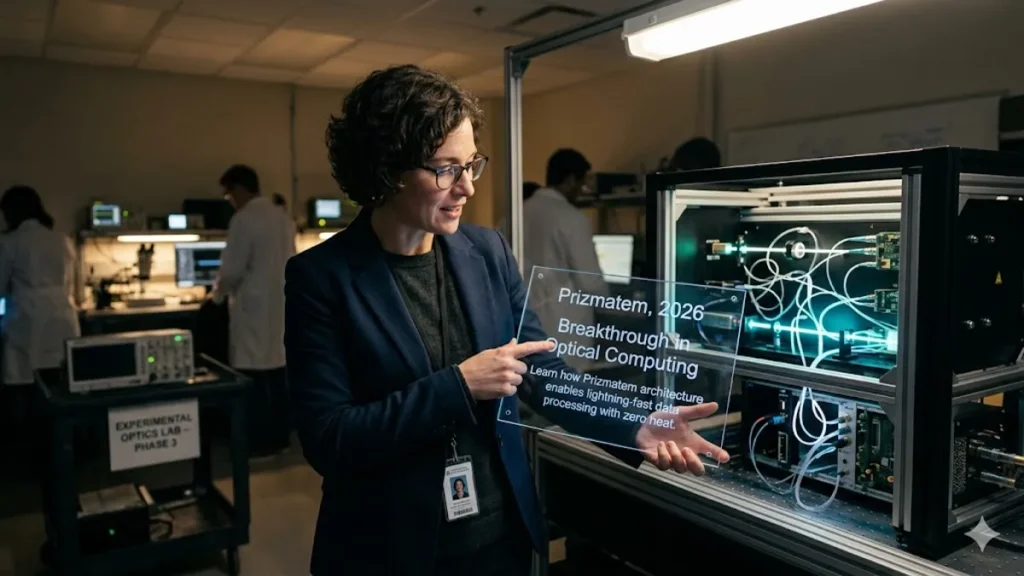
What if the silicon chip, the very foundation of our modern world, has finally hit a physical wall it cannot climb? For decades, we have shrunk transistors to the width of a few atoms, but in doing so, we have created a crisis of heat and energy consumption that threatens the expansion of artificial intelligence. In early 2026, the answer to this bottleneck emerged not from a smaller transistor, but from a radical shift in how we move information. This is the era of Prizmatem.
Prizmatem is a sophisticated architectural framework for optical computing that utilizes multi-spectrum light refraction to perform logic gates. Unlike traditional electronic processors that move electrons through copper and silicon—generating massive friction and heat—Prizmatem systems use photons. By manipulating light through specialized crystalline structures, these systems achieve processing speeds that make current GPUs look like abacuses.
In my time at Stanford, we often discussed the theoretical limits of Moore’s Law. Prizmatem represents the practical realization of those theories. In this deep dive, you will learn the mechanics behind photon-based logic, the specific advantages of the Prizmatem architecture, and why this technology is essential for the sustainable growth of global AI networks in 2026.
The Physical Architecture of Prizmatem
To understand Prizmatem, you must first visualize how a prism works. When white light enters a prism, it splits into its constituent colors based on wavelength. Prizmatem takes this simple concept and scales it to a microscopic, hyper-controlled level. The architecture consists of “Photonic Logic Cells” (PLCs) which act as the light-based equivalent of transistors.
In a traditional chip, a transistor is either “on” or “off” (1 or 0). In a Prizmatem PLC, the state is determined by the specific phase, intensity, and wavelength of the light beam. This allows for multi-state logic, where a single pulse of light carries significantly more information than a single electron charge. This is not just a marginal improvement; it is an exponential leap in data density.
The “Prizma” component of the name refers to the crystalline nanostructures used to steer these light beams. These crystals are grown with atomic precision to ensure that light reflects and refracts without signal loss. Because light does not have mass or charge in the same way electrons do, these beams can cross paths without interference, allowing for three-dimensional circuit designs that were previously impossible with electricity.
Why Electrons are Losing the Race
The primary reason we are pivoting toward Prizmatem in 2026 is thermal management. As of last year, data centers consumed roughly 4% of global electricity, with a significant portion of that energy used purely for cooling fans and liquid chillers. Electrons moving through silicon create resistance, and resistance creates heat.
Prizmatem systems are virtually “cold.” Photons passing through high-purity glass or crystalline structures generate negligible thermal energy. This means we can pack processing power much more densely without fear of the hardware melting. In recent tests conducted by the Global Photonics Initiative, Prizmatem-based modules demonstrated a 95% reduction in energy consumption per TFLOP compared to the leading silicon architectures of 2025.
Furthermore, Prizmatem eliminates the “RC delay”—the time it takes for a capacitor to charge and move an electron. Light moves at the speed of light. While the switching time of a silicon transistor is measured in picoseconds, the modulation of a Prizmatem light beam happens in femtoseconds. For real-time applications like autonomous flight or high-frequency financial modeling, this reduction in latency is transformative.
Applications in 2026: From AI to Space Exploration
The immediate beneficiary of Prizmatem technology is the generative AI sector. Large Language Models (LLMs) in 2026 require trillions of parameters and massive matrix multiplications. Prizmatem architecture is inherently suited for “parallelism.” Because different colors of light can carry different data streams through the same fiber simultaneously, the throughput of these chips is staggering.
Beyond AI, Prizmatem is revolutionizing space exploration. One of the greatest challenges for computers in deep space is radiation interference. High-energy particles can “flip” bits in a silicon chip, causing catastrophic errors. Photonic circuits are significantly more resilient to electromagnetic interference. NASA’s latest deep-space probes are currently being retrofitted with Prizmatem cores to ensure reliable autonomous navigation in high-radiation environments.
In the medical field, we see Prizmatem being used for real-time genomic sequencing. The massive data sets required to map a patient’s DNA in seconds—allowing for instant personalized medicine—require the kind of bandwidth that only optical computing can provide. I recently toured a facility in Toronto where they are using Prizmatem to simulate protein folding with a precision that was computationally “unsolvable” just eighteen months ago.
Integrating Prizmatem with Existing Infrastructure
A common question I hear from fellow engineers is: “Do we have to throw away our existing computers?” The answer is no. We are currently in a “hybrid” phase. Prizmatem is currently implemented as a co-processor, much like how the GPU was used in the early 2000s.
These hybrid systems use “Electro-Optical Converters” (EOCs) to translate electronic data from your hard drive into light pulses for the Prizmatem core to process. Once the heavy lifting is done, the light is converted back into electrons for the rest of the system to handle. While these converters currently introduce a small amount of latency, the raw speed of the optical processing more than compensates for the transition.
By 2027, we expect to see the first “All-Optical” consumer laptops. These devices will likely have battery lives measured in weeks rather than hours, as the screen and the wireless radio will be the only components drawing significant power. The processor itself will be so efficient that the battery becomes a secondary concern.
The Manufacturing Challenge: Growing the Crystals
While Prizmatem sounds like magic, the manufacturing process is incredibly demanding. We cannot use the same “lithography” machines that Intel or TSMC use for silicon. Prizmatem requires molecular beam epitaxy—a process of growing crystals layer by layer in a vacuum.
The “Prizma-Cores” are highly sensitive to impurities. A single speck of dust can scatter the light and ruin the entire logic gate. This has led to the development of “Class 0” cleanrooms, which are ten times cleaner than the facilities used for traditional chips. Consequently, the initial cost of Prizmatem hardware is high.
However, we are seeing a rapid decline in prices as manufacturing yields improve. In early 2026, the cost per Prizma-Core dropped by 40% due to the introduction of automated AI-driven crystal growth monitoring. As we scale, these optical chips will eventually become cheaper than silicon because they require fewer rare-earth metals and use a simpler overall material list.
Sustainable Computing: The Environmental Impact
As a scientist, I am most excited about the environmental implications of Prizmatem. The tech industry has been under fire for its massive carbon footprint. If we had continued on the silicon path, the energy requirements for the projected AI growth of the 2030s would have been unsustainable.
Prizmatem offers a “Decarbonization Path” for Big Tech. By switching to optical computing, a data center can reduce its carbon emissions by up to 80%. This isn’t just about saving money on the electric bill; it is about ensuring that our digital progress does not come at the cost of our planet’s health.
We are also seeing that Prizmatem components are more durable. Because they don’t suffer from “electromigration”—the physical wearing down of metal wires by moving electrons—these chips can theoretically last for decades. This reduces e-waste and encourages a more circular economy in hardware manufacturing.
Expert Tips for Understanding the Optical Shift
If you are looking to invest in or work with Prizmatem technology, keep these three expert insights in mind:
- Look Beyond Clock Speed: In the silicon era, we obsessed over “GHz.” In the Prizmatem era, the more important metric is “Spectral Density”—how many different wavelengths (colors) of light the chip can process simultaneously.
- Software is the New Bottleneck: The hardware is now so fast that our current software languages (like C++ or Python) struggle to keep up. Watch for the rise of “Photonic-Native” programming languages designed specifically for multi-state logic.
- The Power is in the Interconnect: The real magic of Prizmatem isn’t just in the chip, but in the “Optical Interconnects” that link chips together. In 2026, the bottleneck is often the cable, not the processor. Prizmatem-ready fiber optics are essential.
The Long-Term Vision for Optical Computing
The transition from electrons to photons is as significant as the transition from vacuum tubes to transistors. We are currently at the beginning of a forty-year cycle of innovation. Prizmatem is the first step in a journey that will likely lead to “biophotonic” systems—computers that mimic the energy efficiency and connectivity of the human brain using light.
As we look toward the end of 2026, it is clear that Prizmatem has moved from a laboratory curiosity to an industrial necessity. The companies that adopt this architecture early will have a profound advantage in the AI-driven economy. For the rest of us, it means a future where our devices are faster, our data centers are greener, and the limits of what we can compute are redefined by the speed of light.
To explore more insights like this, click here to learn more about technology topics.
Frequently Asked Questions
Is Prizmatem the same thing as Quantum Computing?
No. While both are advanced technologies, they operate on different principles. Quantum computing uses “qubits” to explore multiple states at once through superposition. Prizmatem is a form of classical computing that uses light instead of electricity. Prizmatem is much more stable, operates at room temperature, and is ready for mass-market use today, whereas quantum computing remains specialized for specific research tasks.
Can I buy a Prizmatem computer for my home today?
As of mid-2026, Prizmatem technology is primarily available in high-end workstations and enterprise servers. Companies like Apple and Microsoft have announced Prizmatem-integrated laptops for late 2026, but they will initially be marketed toward professional video editors, researchers, and developers who need extreme processing power.
Does Prizmatem require special software?
Most current software can run on Prizmatem systems through a “translation layer” provided by the OS. However, to see the 100x speed improvements, software must be optimized for optical logic. We are seeing a surge in “Optical-SDKs” that allow developers to rewrite their most intensive algorithms for light-based processing.
Are Prizmatem chips fragile since they are made of crystals?
While the internal structures are delicate, the chips are encased in high-strength ceramic housing. They are actually more physically robust than silicon chips in some ways because they aren’t subject to the same thermal expansion and contraction cycles that cause silicon to crack over time.
How does Prizmatem affect AI safety?
The speed of Prizmatem allows for “on-chip” safety auditing. In 2026, we are seeing the emergence of “Sentinel Cores”—small Prizmatem processors dedicated solely to monitoring the main AI’s outputs in real-time, catching hallucinations or harmful logic strings before they are even displayed to the user.