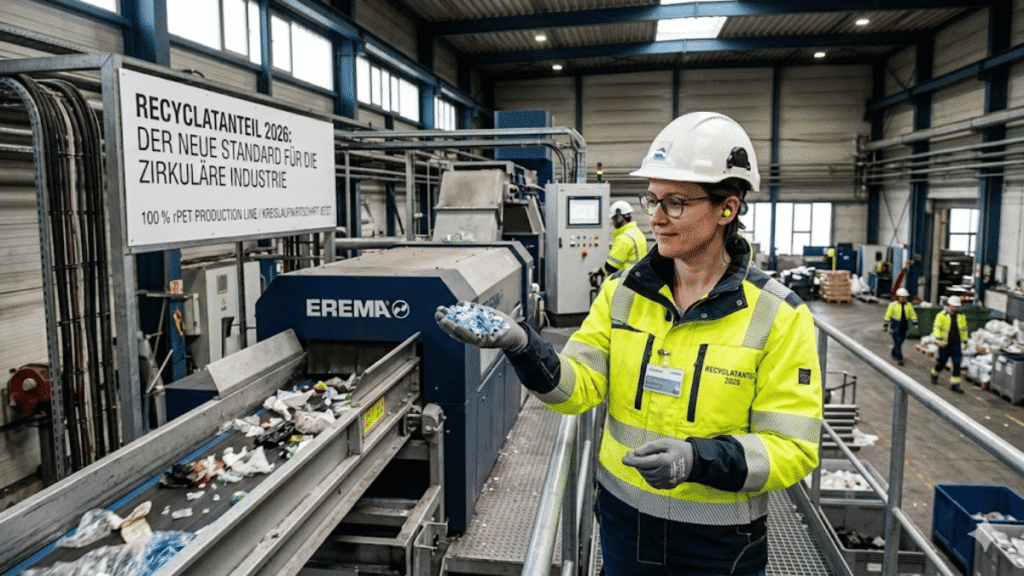
The shift from voluntary sustainability to mandatory compliance has reached a critical tipping point in 2026. For businesses operating within the European market, the term Recyclatanteil—the proportion of recycled material within a product or its packaging—is no longer a marketing “nice-to-have.” It is now a core regulatory requirement under the finalized Packaging and Packaging Waste Regulation (PPWR). As of August 12, 2026, new harmonized labeling and documentation obligations have officially taken effect, forcing a massive recalibration of global supply chains. You will learn the specific quotas hitting different material classes, the technical challenges of maintaining material integrity, and the strategic steps necessary to ensure your products remain market-compliant in this new circular era.
The Regulatory Framework: Recyclatanteil in 2026
The implementation of Regulation (EU) 2025/40 has fundamentally changed how we calculate and report recycled content. While the most aggressive mandatory quotas for plastic are slated for 2030, 2026 serves as the “Documentation and Design” baseline. Every piece of packaging sold in the EU must now carry a Declaration of Conformity (DoC) that verifies its recyclability and current Recyclatanteil.
This regulatory move aims to decouple economic growth from virgin resource consumption. By mandating a specific percentage of post-consumer recycled (PCR) material, the EU is effectively creating a guaranteed market for the recycling industry. For business leaders, this means the cost of “virgin” plastic is no longer just the market price; it now includes the potential regulatory penalties and higher Extended Producer Responsibility (EPR) fees associated with lower-recycled-content materials.
Material-Specific Quotas and Targets
Understanding your specific category is vital, as the “one size fits all” approach to Recyclatanteil has been discarded in favor of nuanced, material-specific benchmarks.
Plastic Packaging Dynamics
While the 2030 target for PET beverage bottles stands at 30%, 2026 has introduced mandatory reporting for contact-sensitive packaging. If you are in the food or pharmaceutical sectors, the challenge is maintaining safety standards while incorporating PCR resins. The industry has seen a massive surge in chemical recycling (advanced recycling) investments to ensure that the Recyclatanteil in food-grade plastics meets purity requirements without compromising structural integrity.
Paper, Glass, and Metal
Non-plastic materials face even steeper expectations due to their established recycling infrastructure. In 2026, the industry standard for “best-in-class” paper packaging has moved toward a 70% Recyclatanteil, while glass manufacturers are pushing for 50% or higher. Metal, specifically aluminum, remains the gold standard for circularity, with many automotive and consumer electronics brands achieving nearly 100% closed-loop recycling for specific components.
Strategic Supply Chain Adaptation
Increasing your Recyclatanteil is not as simple as swapping one pellet for another. It requires a fundamental rethink of the manufacturing process.
The primary hurdle in 2026 remains feedstock consistency. Recycled materials often exhibit variations in color, viscosity, and tensile strength compared to their virgin counterparts. To combat this, leading firms are adopting “Digital Product Passports” (DPP). These blockchain-based logs track the material from the initial waste collection point through the reprocessing facility and into the final product. This level of traceability is becoming the only way to satisfy auditors that your claimed Recyclatanteil is accurate and not a result of “greenwashing.”
Furthermore, businesses are now auditing their suppliers with a focus on “Design for Recycling” (DfR). If a package uses multi-layer films or inseparable adhesives, it lowers the overall recyclability grade, which in turn makes it harder to recover high-quality recyclate for future use. The goal is to create a “virtuous cycle” where the product you sell today becomes the high-quality raw material you buy tomorrow.
The Economic Impact of High Recyclatanteil
From a financial perspective, the 2026 landscape rewards early adopters. Under the “Eco-Modulation” of EPR fees, companies with a higher Recyclatanteil pay significantly lower environmental taxes. In some jurisdictions, the difference in fees between a “Grade A” (95% recyclable) and “Grade D” package can be as much as 40%.
There is also the matter of brand equity. Consumers in 2026 are increasingly literate in sustainability metrics. They look for the “Recyclat” percentage on the back of the bottle just as they once looked for “Low Fat” labels on food. Brands that can transparently prove a high Recyclatanteil are seeing higher loyalty rates, particularly among the 22-40 demographic who view circularity as a non-negotiable brand value.
Expert Tips for Enhancing Recyclatanteil
Achieving compliance while maintaining profitability requires a sophisticated approach to material science and procurement. Here are three expert-level strategies:
- Switch to Mono-Materials: Wherever possible, eliminate multi-polymer laminates. Mono-material packaging (like all-PE or all-PP) is vastly easier to process back into high-quality recyclate, which stabilizes your long-term supply.
- Invest in “Off-Take” Agreements: The demand for high-quality PCR is outstripping supply. Secure your 2027 and 2028 material needs now through long-term contracts with reputable recyclers to avoid price volatility.
- Optimize for “Visual Imperfection”: Educate your marketing team and customers that a slight grayish tint or minor inclusions in plastic are “badges of sustainability.” Using excessive pigments to hide recycled content can actually make the material harder to recycle in the next loop.
Frequently Asked Questions
What is the difference between PCR and PIR in Recyclatanteil?
PCR (Post-Consumer Recycled) material comes from products used and disposed of by households. PIR (Post-Industrial Recycled) comes from manufacturing scrap. Current 2026 EU regulations, specifically the PPWR, prioritize PCR content because it directly addresses the municipal waste problem.
How is the Recyclatanteil officially calculated?
The calculation is typically based on the mass balance approach. You divide the total mass of recycled secondary raw materials by the total mass of the packaging or product. Under the 2026 guidelines, this must be verified by a third-party auditor and documented in the Technical File.
Can chemical recycling count toward the Recyclatanteil?
Yes, as of 2026, the EU has provided a clearer framework for including chemically recycled plastics in the quota, provided the “chain of custody” is strictly maintained. This is particularly important for food-contact materials where mechanical recycling often falls short of hygiene standards.
What are the penalties for not meeting Recyclatanteil quotas?
While the harshest fines start in 2030, 2026 marks the beginning of “Market Access” restrictions. Products with incorrect labeling or missing Declarations of Conformity can be pulled from shelves. Fines for non-compliance can reach up to 4% of a company’s annual turnover in certain EU member states.
Does a higher Recyclatanteil always mean a lower carbon footprint?
Not necessarily, but in most cases, yes. While the processing of recycled material requires energy, it is almost always less energy-intensive than extracting and refining virgin raw materials. In 2026, life-cycle assessments (LCAs) are used to ensure that the recycling process itself doesn’t outweigh the benefits of material recovery.
The Path Forward: Circularity as a Competitive Edge
As we navigate the complexities of 2026, it is clear that Recyclatanteil has moved from the periphery of corporate social responsibility to the center of the balance sheet. The companies that will thrive are those that view these regulations not as a burden, but as a catalyst for innovation. By mastering the technical, legal, and economic nuances of recycled content, you aren’t just complying with the law—you are future-proofing your business against the inevitable scarcity of virgin resources. Circularity is the new “lean manufacturing,” and the Recyclatanteil is its most important metric.