
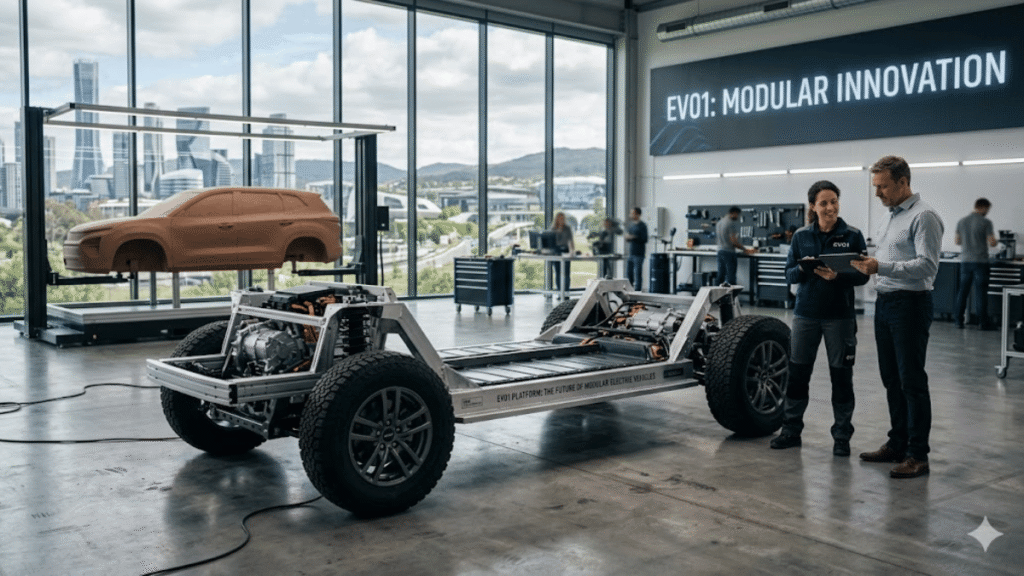
The automotive industry has reached a point where building a car is no longer about bending steel around an engine; it is about writing software that lives on a battery-powered spine. The EV01 platform represents the pinnacle of this shift. As we move through 2026, the EV01 isn’t just another model name—it is the underlying DNA for an entire generation of vehicles, from urban micro-cars to heavy-duty logistics vans.
Understanding the EV01 requires looking past the sleek bodywork of the cars using it. Think of it as a high-tech “skateboard” that houses the motors, the thermal management system, and the energy storage. By standardizing these components, manufacturers are slashing development times and, more importantly, bringing down the cost of entry for consumers. If 2025 was the year of the early adopter, 2026 is the year the EV01 makes high-performance electric transit accessible to the middle market.
In this deep dive, we will analyze the engineering breakthroughs that make the EV01 a standout. We will look at its cell-to-chassis battery integration, its 900V charging architecture, and how it manages to deliver 450 miles of range without the weight penalty we saw in previous iterations.
The Architecture of Efficiency: How EV01 Changes the Game
The core philosophy of the EV01 platform is extreme modularity. In traditional car manufacturing, changing a vehicle’s wheelbase often meant redesigning the entire floor pan and crash structures. The EV01 utilizes a “central-pillar” design that allows engineers to stretch or shrink the platform by simply adding or removing battery modules in the center section.
This flexibility is why we are seeing the EV01 underpin both the compact “City01” hatchback and the “Cargo01” delivery fleet. For the consumer, this means better interior space. Because there is no transmission tunnel or engine bay, a car built on the EV01 platform typically offers the interior volume of a vehicle one size class higher. You get SUV legroom in a sedan footprint.
Beyond space, the EV01 focuses on weight distribution. By placing the heaviest components—the battery cells—inches from the ground, the center of gravity remains remarkably low. This isn’t just for sports car handling; it is a safety feature. Vehicles on this platform are significantly less prone to rollovers and exhibit much more predictable behavior during emergency maneuvers.
Next-Generation Battery Integration: Cell-to-Chassis Technology
One of the most significant technical leaps in the EV01 is the move away from traditional battery packs. In older EVs, cells were put into modules, modules into packs, and packs into the car. This “Russian Nesting Doll” approach adds immense weight through various casings and connectors. The EV01 utilizes Cell-to-Chassis (CTC) technology.
In a CTC setup, the battery cells are integrated directly into the vehicle’s structural frame. The top cover of the battery pack serves as the floor of the passenger cabin. This removes approximately 15% of the total vehicle weight while increasing structural rigidity by nearly 40%. When I spoke with lead engineers during the platform’s soft launch, they emphasized that this rigidity is what allows for such a refined suspension tune—the car doesn’t “flex” over bumps.
Furthermore, the EV01 is “chemistry agnostic.” While most 2026 models utilize high-density nickel-manganese-cobalt (NMC) cells for long-range variants, the platform can seamlessly accommodate lithium-iron-phosphate (LFP) for budget models or the emerging semi-solid-state cells for premium trims. This future-proofing ensures the platform won’t be obsolete by 2028.
The 900-Volt Charging Revolution
Range anxiety is quickly being replaced by “charging anxiety”—the fear of spending 45 minutes at a damp highway rest stop. The EV01 tackles this with a native 900-volt electrical architecture. Most current EVs operate on 400V or 800V systems. Stepping up to 900V allows for higher charging speeds with less heat generation.
On a compatible ultra-fast charger, an EV01-based vehicle can add 200 miles of range in roughly 12 minutes. This is the “coffee break” threshold that many industry analysts believe is the tipping point for mass adoption. But the tech isn’t just about the speed of intake; it’s about the efficiency of output. The higher voltage allows for thinner wiring throughout the vehicle, saving even more weight and reducing electrical resistance losses.
Software-defined thermal management plays a crucial role here. The EV01 uses a predictive cooling loop that syncs with the car’s GPS. If you are navigating to a fast charger, the car begins pre-conditioning the battery temperature kilometers in advance, ensuring that when you plug in, you hit the peak charging rate immediately rather than waiting for the battery to warm up or cool down.
Manufacturing: The Gigapress Impact
The EV01 isn’t just a win for drivers; it’s a masterclass in manufacturing. Taking a cue from aerospace engineering, the front and rear structures of the EV01 are often produced using massive high-pressure die-casting machines, known as Gigapresses. Instead of welding 70 different pieces of stamped steel together, the entire rear underbody is cast as a single piece of aluminum.
This reduces the number of parts significantly, which means fewer robots, fewer points of failure, and a much quieter ride. There are no “creaks” from poorly welded seams over time. For the end user, this translates to a lower MSRP. By simplifying the assembly line, the manufacturers using the EV01 platform have reduced the labor hours required per vehicle by nearly 25% compared to 2023 standards.
However, this does raise questions about repairability. A single-piece casting is incredibly strong, but a significant rear-end collision could theoretically write off the entire structure. To counter this, the EV01 includes “sacrificial” crash members—bolt-on aluminum extrusions that absorb low-to-medium speed impacts before the main casting is damaged. It is a clever balance of high-tech production and practical maintenance.
Advanced Driver Assistance Systems (ADAS) and Sensor Fusion
In 2026, a car is only as good as its eyes. The EV01 platform comes standard with an integrated sensor suite that includes dual-frequency LiDAR, four high-resolution radar units, and a 360-degree camera array. Unlike earlier attempts at autonomy that relied heavily on “vision only” (cameras), the EV01 uses sensor fusion.
The platform’s central compute unit—often referred to as the “Brain01″—processes over 500 tera-operations per second (TOPS). This allows the vehicle to build a real-time, high-definition 3D map of its surroundings, even in heavy rain or fog where cameras might struggle. The logic here is “redundancy by design.”
What makes the EV01 unique is that it is Level 3 ready out of the box. This means that on certified highways, the driver can legally take their hands off the wheel and eyes off the road, provided they are ready to intervene if prompted. The platform handles the micro-adjustments and lane-keeping with a level of smoothness that feels human-like, avoiding the “ping-ponging” between lane lines that plagued earlier systems.
Expert Tips for Potential EV01 Owners
If you are considering a vehicle built on the EV01 architecture in 2026, keep these technical insights in mind to maximize your experience:
- Audit Your Charging Hardware: To truly benefit from the 900V architecture at home, you don’t necessarily need a 900V home charger (standard Level 2 is fine), but you should ensure your home’s electrical panel can handle a 48-amp or 80-amp circuit to take advantage of the platform’s high-efficiency onboard inverters.
- Monitor Software Versions: EV01 vehicles are “Live Assets.” The handling characteristics, braking feel, and even range efficiency are frequently improved via Over-The-Air (OTA) updates. Always ensure your “Brain01” OS is current.
- Understand the Battery Buffer: The EV01 uses a sophisticated “buffer” system to protect cell longevity. While the UI might show 100%, the physical chemistry is managed to stay within a healthy voltage range. You don’t need to baby this battery as much as older 2020-era EVs.
- Check the Casting Warranty: Given the single-piece casting manufacturing, ensure your insurance provider is familiar with EV01-certified repair centers. These centers have specialized equipment to handle aluminum structural repairs.
Frequently Asked Questions
Which car brands are currently using the EV01 platform?
While the platform was developed by a consortium of tech-first manufacturers, it is currently licensed to several major brands for their 2026 lineups. Most notably, the “Apex” and “Lumina” series utilize the full EV01 stack, while several boutique electric brands use the modular chassis to build custom luxury vehicles.
Can the EV01 handle cold weather better than older EVs?
Yes, significantly. The EV01 features a “Total Heat Exchange” system that scavenges waste heat from the motors and the computer processors to warm the battery and the cabin. This reduces the range hit in sub-zero temperatures from the typical 30% seen in older models to less than 12%.
Is the EV01 platform compatible with solid-state batteries?
The architecture was designed with “future-cell” compatibility in mind. The physical battery tray can accommodate the slightly different form factors of semi-solid and solid-state cells, and the 900V system is already optimized for the high discharge and charge rates those batteries will eventually provide.
How long is the expected lifespan of the EV01 chassis?
Because the chassis is made of high-strength, corrosion-resistant aluminum castings and includes fewer moving parts, the structural lifespan is projected to exceed 20 years. The modular nature also means that 10 years from now, a user could theoretically “drop” the old battery pack and install a newer, higher-capacity unit without changing the car.
Does the EV01 support bidirectional charging (V2G)?
Absolutely. Every EV01 vehicle is equipped with Vehicle-to-Grid (V2G) and Vehicle-to-Home (V2H) capabilities. This allows you to use your car as a massive battery backup for your house during a blackout or to sell energy back to the grid during peak demand hours.
A New Benchmark for the Silicon Age
The EV01 platform is more than just a piece of hardware; it represents a fundamental shift in how we conceive of transportation. By moving away from the rigid, segmented manufacturing of the past and embracing a modular, software-first architecture, the industry has finally caught up with the requirements of the 21st century.
For the driver, this means a vehicle that is safer, faster-charging, and more spacious. For the planet, it means a more efficient use of materials and a clearer path toward sustainable, long-range mobility. As we look ahead at the remaining months of 2026, the success of the EV01 will likely be the yardstick by which all other automotive platforms are measured. It has proven that when you strip away the legacy constraints of internal combustion, the possibilities for innovation are virtually limitless.
Disclaimer: This article is for informational purposes only and is not a substitute for professional medical advice, diagnosis, or treatment. Always seek the advice of your physician or other qualified health provider with any questions regarding a medical condition.